Trump’s “Ratepayer Protection” Pitch Becomes a Private Power Plan for AI — But Grassroots Revolt Won’t Fade – Music Technology Policy
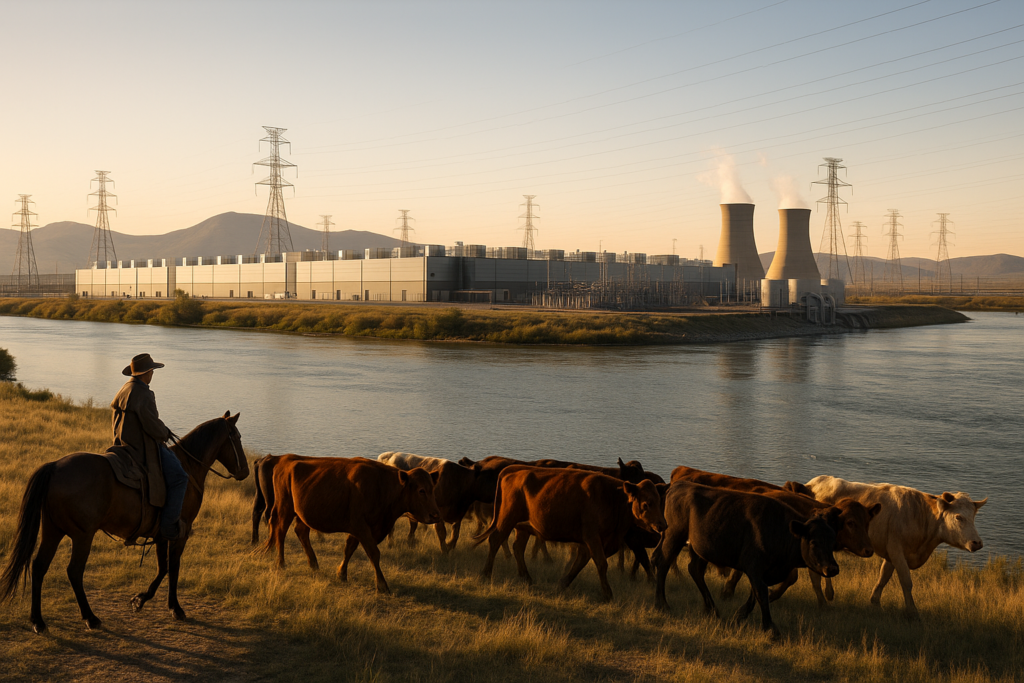
Across the United States from the Texas Hill Country to Northern Virginia, from Nevada to the Carolinas, communities have been confronting a new kind of industrial development: hyperscale construction of AI data centers in the neighborhood. What began as an abstract debate about artificial intelligence industrial strategy has become a very tangible largely local grassroots organizing confrontation over land use, water consumption, transmission lines, substations, diesel backup generation, and above all, electricity prices.
Grassroots opposition did not emerge from anti-technology ideology. It emerged from power bills. But it won’t end with power bills.
Residents have watched utilities propose multi-billion-dollar transmission upgrades, newly built “peaker plants” (power plants that run only during periods of highest electricity demand), expanded substations, and novel “large load” tariff structures — all justified by projected demand from hyperscalers building AI infrastructure. Amazon (AWS) is building campuses in northwest Louisiana and northern Indiana. Google is developing new sites in Wilbarger County, Texas, and Pine Island, Minnesota. Microsoft is completing a massive AI datacenter in Wisconsin. Meta is expanding large AI campuses also in Louisiana and Minnesota.

In many jurisdictions, utilities seek to socialize the upfront infrastructure costs while promising that future load growth will eventually stabilize rates. That assurance has not been universally persuasive. Ratepayers understand a simple fact: when utilities overbuild and guaranteed returns are locked in, customers often carry the risk.
For example, in PJM’s footprint (the mid-Atlantic/Midwest grid), the Union of Concerned Scientists found that utility customers in seven PJM states paid more than $4.3 billion in 2024 for local transmission upgrades needed to bring data centers online. Those costs are recovered broadly through rate increases rather than billed solely to the new loads. In Georgia, regulators approved Georgia Power’s $16.3 billion capacity expansion plan driven largely by data-center demand, while critics warn that—with financing and regulated returns—the ultimate burden could reach $50–$60 billion if forecasts miss and costs are shifted onto ordinary customers. And in Virginia, the fight has become explicit: Dominion has described a new data-center rate class requiring big users to pay ~85% of projected costs upfront and sign long contracts. That’s an acknowledgement that the default pathway risks pushing grid-upgrade costs into general rate payers first, then trying to fix the cost-shift later.
At the same time, policymakers have struggled to explain why companies with trillion-dollar market capitalizations should require ratepayer-backed grid expansion at all. The optics are stark. There’s no question, ordinary households, the “little platoons,” face rising electricity costs and, in some regions, reliability warnings. Oh yes, not only will you pay through the nose for the same thing you had before data center apocalypse, you could also get blackouts and brownouts. Meanwhile, AI companies race to secure gigawatts of capacity for training clusters that operate around the clock. The perception is one of cost shifting: privatize the upside, socialize the downside.
Let me clear, I don’t mind rates going up—but only if hyperscalers want to finance the plants outright. If trillion-dollar AI companies are willing to retire the public debt incurred to build this infrastructure in the first place, ratepayers might reasonably view higher bills as investment rather than involuntary subsidy or cost shifting.
This tension has produced a rare political coalition. Rural landowners concerned about transmission corridors have found common cause with urban consumer advocates worried about affordability. Environmental groups concerned about water withdrawals and fossil backsliding overlap with fiscal conservatives skeptical of subsidized infrastructure. State public utility commissions have become the frontline battleground, with debates over large load tariffs, special contracts, behind-the-meter generation, and whether AI demand forecasts are being overstated.

Into this environment stepped President Trump, reframing the controversy during his State of the Union as a populist fairness issue. Rather than emphasizing demand restraint or tighter regulatory guardrails, he promoted a “build your own power” model — encouraging AI companies to finance and operate dedicated generation resources, effectively a private power grid for hyperscalers.
On its face, the rhetoric sounds aligned with grassroots concerns: if AI companies want massive amounts of electricity, let them pay for it themselves. But the details matter. President Trump’s proposal is billed as ratepayer protection, but does not offer any immediate bill relief to ratepayers facing rising costs today.
Nor does it necessarily prevent grid entanglement, cost recovery mechanisms, transmission expansion, or indirect rate impacts. In fact, by politically endorsing accelerated AI infrastructure build-out even under a “private power” banner the plan may intensify opposition in communities already feeling overwhelmed.
No Immediate Relief — A Future Cost-Avoidance Theory
President Trump’s proposal is fundamentally forward-looking and almost aspirational in its timing. The logic is straightforward: if hyperscalers finance their own generation capacity and the incremental infrastructure required to serve it, then ordinary households should, in theory, be insulated from the cost impacts of explosive data-center load growth. The political framing is “fairness”: and “protection”, those who create the demand pay for the supply. Sound good? Now back to sleep.
But that theory operates on a multi-year construction horizon, not a monthly billing cycle.
Newly built power generation whether gas, nuclear, renewable plus storage, or some hybrid configuration has a long lead time. It requires siting, permitting, financing, interconnection studies, transmission upgrades, procurement, and construction. Even expedited projects typically take years before producing a single megawatt-hour. During that period, utilities are still investing in grid upgrades, substations, transmission reinforcements, and reliability reserves to accommodate anticipated demand. Those costs enter rate cases long before new private generation materially offsets them.
Just as important, the proposal does not create immediate bill credits. It does not refund prior infrastructure spending. It does not retire existing transmission investments already approved based on projected data-center load. And it does not directly address current rate increases tied to inflation, fuel costs, storm recovery, or prior capital expenditures.

In other words, the speech described who might pay for infrastructure that has yet to be built. It did not offer a present-day mechanism to lower consumer bills already rising today. For households experiencing higher electricity costs now, the distinction matters. A lot. A promise about future cost allocation does not function as immediate rate relief.
This lead time will certainly exceed a single presidential election cycle. Infrastructure permitting, financing, and construction routinely span four to eight years — meaning voters feel the rate impacts now, while any promised insulation arrives well after the next national vote.
The political messaging suggests insulation; the economic reality suggests a lag. And in a climate where grassroots opposition is driven by today’s bills, not theoretical future equilibrium, that gap may prove consequential. The promise of future ratepayer protection sounds a bit like J. Wellington Wimpy’s pledge to “gladly pay you Tuesday for a hamburger today.” Households are paying higher electric bills now, while relief is deferred to an uncertain future — dependent on projects, financing, and political will that may never fully materialize.

A Populist Frame: The “Private Power Grid for AI”
The speech revealed a deeper political repositioning. Trump reframed the data-center electricity fight as a fairness issue: if AI companies want massive power, they should build their own not make ordinary Americans pay for it. In effect, he is promoting a parallel, privately funded power system for AI infrastructure — a “private power grid for AI.”
In classic—and I mean classic—Trumpian sleight of hand, the move reframes expansion as protection. It’s not three-day old fish, it’s a whole new thing. You gotta hand it to the guy. What sounds like shielding households from rising electricity costs is, in effect, a green light for even more build-out. By branding it as fairness — “they build their own power” — he recasts industrial acceleration as consumer relief. The rhetorical pivot is about as subtle as a punch in the mouth: instead of debating whether AI demand should be constrained, the focus shifts to who finances both the current and the next wave. The result is a parallel private power grid for AI sold as insulation for ratepayers while normalizing even greater infrastructure expansion. You know, because China.
This framing validates public anger over electricity cost shifting, positions the administration as defending ratepayers, and simplifies a complex infrastructure issue into a populist narrative. But a private grid is not truly separate. Data centers would still rely on transmission, backup power, and grid stability, while communities could still face environmental, water, and land-use impacts from combined data center and generation projects.

A Strategic Win for AI Acceleration
If the debate shifts from whether AI infrastructure should slow down to simply who pays for it, the acceleration trajectory remains intact. The populist framing addresses cost shifting while leaving the scale of expansion largely untouched. In practical terms, ratepayer anger is acknowledged, the politics of electricity pricing are addressed, and infrastructure build-out continues — potentially even faster under a self-supply model well after Trump leaves office.
Why Grassroots Opposition Will Not Fade
The future oriented “build your own power” concept does not eliminate the real problem: affordability. Grassroots opposition has never been solely about electricity prices. It is about land use, industrialization, water consumption, environmental impact, transmission corridors, and community consent. A policy that effectively endorses continued — or expanded — data center construction does not reduce those pressures. It confirms them.
The “build your own power plant” pitch doesn’t touch the on-the-ground grievances already fueling local resistance. In Hays County, Texas, water advocates have organized protests against multiple proposed data centers, explicitly framing the fight around local water supplies and growth impacts, not just rates. In Hood County, Texas, residents pushed for a moratorium amid concerns about scale and local control, turning routine county meetings into pitched political fights. In Prince William County, Virginia, community groups have opposed “mega” proposals based on land use, proximity to neighborhoods, and cumulative industrialization, with electricity bills only one piece of a broader quality-of-life and permitting dispute. In Pima County/Tucson, Arizona (“Project Blue”), backlash centered on water sourcing, secrecy, and desert environmental impacts, with the city moving to block access to municipal water—an archetypal “community consent” fight. And in rural Texas, opposition has also focused on transmission corridors themselves—land fragmentation, property impacts, and forced industrial siting—illustrating that even “private power” can still mean public landscape costs.
If hyperscalers pair data centers with dedicated generation, communities may face larger, more explicit industrial energy complexes, not smaller ones. The conflict shifts, but it does not disappear. “Pay your own way” does not mean “build less.” It may mean “build more.”
The Real Test: From Rhetoric to Enforcement
Whether ratepayer protection becomes real depends on implementation — utility commission cost allocation, large-load tariffs, interconnection responsibility, transmission cost recovery, backup pricing, and transparency around data-center load impacts. Without enforceable mechanisms, pledges risk becoming messaging rather than policy.
The administration has now explicitly promoted the idea that AI hyperscalers should supply their own electricity — even build their own power plants — to protect ratepayers. Politically, it is potent. Structurally, it preserves the trajectory of AI infrastructure expansion.
But…at the local level, it does little to ease and may intensify grassroots resistance spreading across communities facing large-scale data center development. For many communities, the fight was never just about the electric bill. It was and remains about the build-out itself.
President Trump may have changed the atmospherics. He may have reframed the rhetoric, shifted the optics, and recast industrial expansion as populist protection. But atmospherics are not weather. Transmission lines still cut across ranchland. Water is still withdrawn from aquifers. Zoning maps still change. Substations still rise beside neighborhoods.
A speech can alter tone. It cannot alter terrain.
If the policy accelerates the same footprint — more campuses, more corridors, more generation — the underlying forces driving local opposition will persist and utility bills will continue to increase. Utilities can have a devastating effect on affordability. Communities aren’t debating messaging; they’re debating land, water, scale, and consent. And no rhetorical high-pressure system in Washington can stop the storm clouds gathering at the county commission level.
In Wag the Dog, Dustin Hoffman’s character Stanley Motss waxes poetic on the role of a producer above almost everyone else in Hollywood. Producers assemble the pieces, create the illusion, shape the narrative, and ultimately control reality itself.
But that’s just the movies.