Can We Sue Our Way to AI Control?
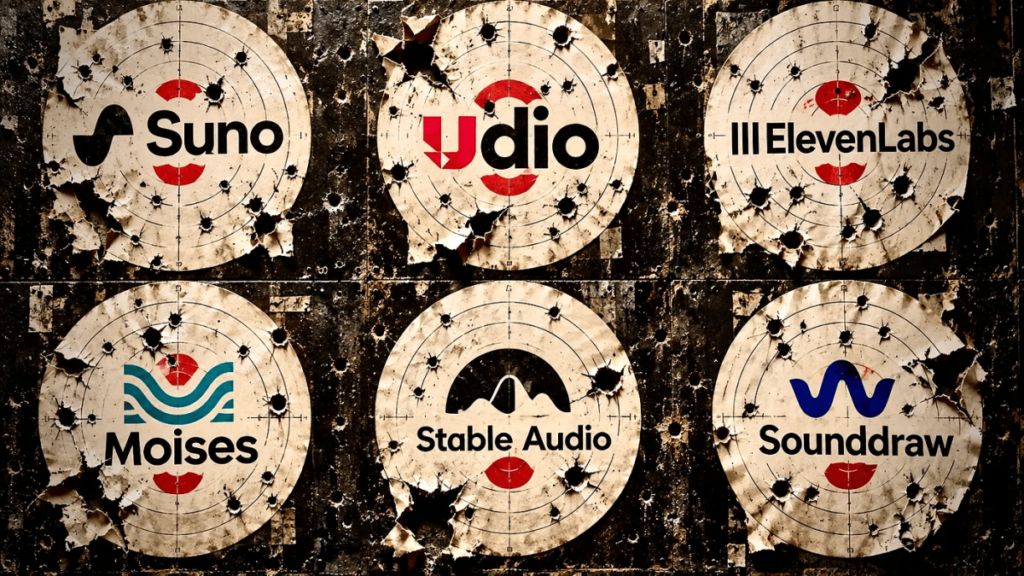
The AI battle rages on but will the legal battle lead to a business worth pursuing?
The labels want their power back. Copyright needs to be rebuilt.
There is a comforting version of the AI music story in which the record labels sue, the technology companies pay, and musicians emerge with their rights intact. The lawyers finish arguing, the executives shake hands, and somebody issues a statement about protecting creativity. We are supposed to recognize this as a happy ending. I would like to see the contract before joining the applause.
The labels are playing defense. They are defending their catalogs, their revenue, and their authority to decide who gets to build a business around those assets. That is an entirely understandable response to a commercial threat. It is also a considerably narrower mission than protecting the future of people who make music, a distinction that tends to disappear somewhere between the settlement and the press release.
An AI company can be a threat on Monday and a strategic partner by Friday, provided the terms become acceptable. Warner Music Group’s settlement and partnership with Suno demonstrates that litigation and collaboration can occupy the same business plan. Its announced licensing and opt-in commitments may provide meaningful protections. They also make something else clear: a company can secure a place in the AI business without resolving what that business will do to the working musician.
The temptation is to call this hypocrisy. I think it is more ordinary, and therefore more troubling. A company defends its assets until it finds an acceptable way to monetize them. Once that happens, its reasons for resisting the technology may become reasons for helping it grow. The artist whose interests aligned with the company during the lawsuit should pay close attention when the incentives change.
A successful licensing agreement could make a catalog more valuable while the people who created it struggle to find their next assignment. Those outcomes are perfectly capable of coexisting. Money can flow to the owner of yesterday’s recordings while demand weakens for tomorrow’s work. There is no contradiction on the balance sheet, which is part of the problem.
This is why I do not believe we can sue our way to adequate AI control. Lawsuits can stop particular conduct, impose consequences, and establish important precedents. They can also end in private agreements that leave the central questions unanswered for everyone else. A settlement tells us that the parties have found terms they can accept. It does not tell us that musicians have acquired a future they can live with.
My conclusion goes further than calling for a few guardrails. Copyright needs to be completely reconceptualized and recreated in the United States and across the world. We need to decide what rights human creators should retain when their work can help build systems that generate competing material at enormous scale. Then we need laws, institutions, and enforcement designed around that reality. Continuing to argue over how far existing categories can stretch is an inadequate substitute for deciding what the system is supposed to accomplish.
That does not mean existing copyright suddenly has no force, or that creators should surrender the protections they already possess. Those rights remain essential during any transition. It means the next system should be designed from first principles, with human authorship, public access, and commercial accountability treated as deliberate choices. We should stop assuming that a sufficient number of lawsuits will eventually assemble a coherent policy on our behalf.
The familiar infringement dispute asks whether someone used protected material in a way the law reserves to its owner. AI adds a larger policy question: what should be required when creative work is used to develop a commercial capacity for producing more creative material? Examining a particular output can matter enormously. But even an output that does not reproduce a recognizable passage leaves questions about the training process, its authorization, and the economic value extracted from the works involved.
A rebuilt system should address those stages explicitly. Acquiring material, using it to train or refine a model, deploying the model commercially, and distributing its outputs should have clearly defined obligations appropriate to each activity. Lawmakers should identify which uses require permission and which qualify for carefully bounded exceptions. Creators and developers should not have to gamble their livelihoods on competing interpretations while a product becomes too commercially entrenched to change without a fight.
That last possibility deserves more skepticism than it gets. Uncertainty can be devastating to a musician trying to establish what happened to their work. A well-financed company may be better positioned to tolerate that uncertainty while it develops a product and builds a customer base. If the dispute eventually becomes a negotiation over payment, delay may have served the stronger party quite well. Calling the situation legally complicated does not make its consequences evenly distributed.
The word “licensed” also needs to lose its power to end the conversation. Permission from a rights holder answers an important question, but it does not establish that the human creator had meaningful bargaining power. Nor does it establish that the creator receives adequate compensation or can inspect the accounting. A beautifully documented agreement can still leave the person who made the music with very little control.
Recreating copyright should therefore include a serious reconsideration of what creators can sign away. I would favor a core of rights that survives a transfer of commercial ownership: meaningful information about machine uses of the work, enforceable accounting where compensation is due, and defined protections against unauthorized commercial replicas of a person’s identity. Some of those protections will require laws beyond copyright itself. A comprehensive rebuild should coordinate them rather than leave the artist to discover which legal category their latest problem happens to occupy.
Training on protected work for commercial generation should have an explicit authorization framework, with defined exceptions rather than an assumption that everything accessible is available. Permission should describe the uses being authorized. Rights over a recording should not silently become unlimited authority over the performer’s voice, identity, or future participation. If a new use requires a new decision, the person entitled to make it should actually be asked.
Transparency has to carry legal force. Developers should maintain auditable records of the material they use and the basis on which they use it, with procedures that let legitimate claims be investigated while protecting unrelated confidential information. A creator should not have to reverse-engineer a commercial system merely to begin asking whether their rights were respected. If the evidence is controlled by the company, the company should have duties to preserve it and make it available through a workable process.
None of this will mean much if enforcement remains a luxury purchase. A major catalog can justify years of litigation; a composer trying to pay the mortgage usually cannot. A recreated system needs accessible claims procedures, workable collective enforcement, and public authorities able to investigate persistent misconduct. A right that becomes useful only after you can afford a legal department is a remarkably selective form of protection.
The redesign also has to preserve the public’s freedom to create. Nobody should acquire ownership of a genre, a mood, a chord progression, or the broad idea of sounding influenced by someone else. Research, criticism, parody, and legitimate transformative expression need room to exist, and the public domain must remain usable. Giving giant catalog owners a veto over culture would be a disastrous response to giving technology companies unchecked access to it.
This cannot be solved by the United States acting as though the rest of the world is an inconvenient distribution territory. A credible international framework would require shared minimum obligations for transparency, authorization, remedies, and recognition of creators’ claims. Countries could retain differences in their legal systems while cooperating on evidence and enforcement. The protections should follow commercial activity across borders rather than depend entirely on where a developer chooses to locate a particular operation.
Otherwise, we risk constructing a system in which companies search for the most permissive place to build a product and sell it into markets whose creators supplied its value. Rules governing access to those markets should address that possibility. International coordination would be difficult, slow, and politically unpleasant. Those are descriptions of the work, not reasons to pretend private licensing can do it instead.
I am under no illusion that governments will approach this with clean hands and perfect judgment. The companies fighting over AI will also lobby over its regulation. A rewrite could become a spectacular opportunity for incumbents to secure advantages they could not win in court. That is why independent creators, smaller businesses, researchers, and the public need a consequential role in the process. Inviting an artist to speak after the important provisions have been negotiated is public relations with a microphone.
Still, government failure is not an argument for corporate self-government. I do not believe broad, durable AI protections will emerge voluntarily from businesses rewarded for expanding what their systems can do and how cheaply they can do it. Responsible participants need rules their competitors must also obey. Artists need rights that do not disappear when someone with a larger catalog accepts an attractive offer.
Even a rebuilt copyright system will not guarantee anyone a career. Law cannot promise that clients will keep commissioning human musicians, and compensation for training cannot automatically replace lost work. Labor policy, competition policy, and the conduct of distributors will matter too. But copyright should at least establish a defensible relationship between the people who create the work and the businesses that turn that work into productive machinery.
The labels may win their lawsuits, secure their licenses, and announce that order has been restored. Their shareholders may have good reason to agree. Artists should reserve judgment until we know what power remains in our own hands and what remedies exist when it is ignored. Being included in the raw material is not the same as being included in the decision.
We can keep treating each settlement as another step toward safety, or we can demand the harder political work of rebuilding the rules in the United States and internationally. I favor the rebuild because I do not trust a collection of private bargains to produce a public good by accident. Without enforceable public obligations, the danger is that the industry will finish negotiating the price of our work before it has seriously considered whether we still have a place in the business. The paperwork may be impeccable when that happens…